

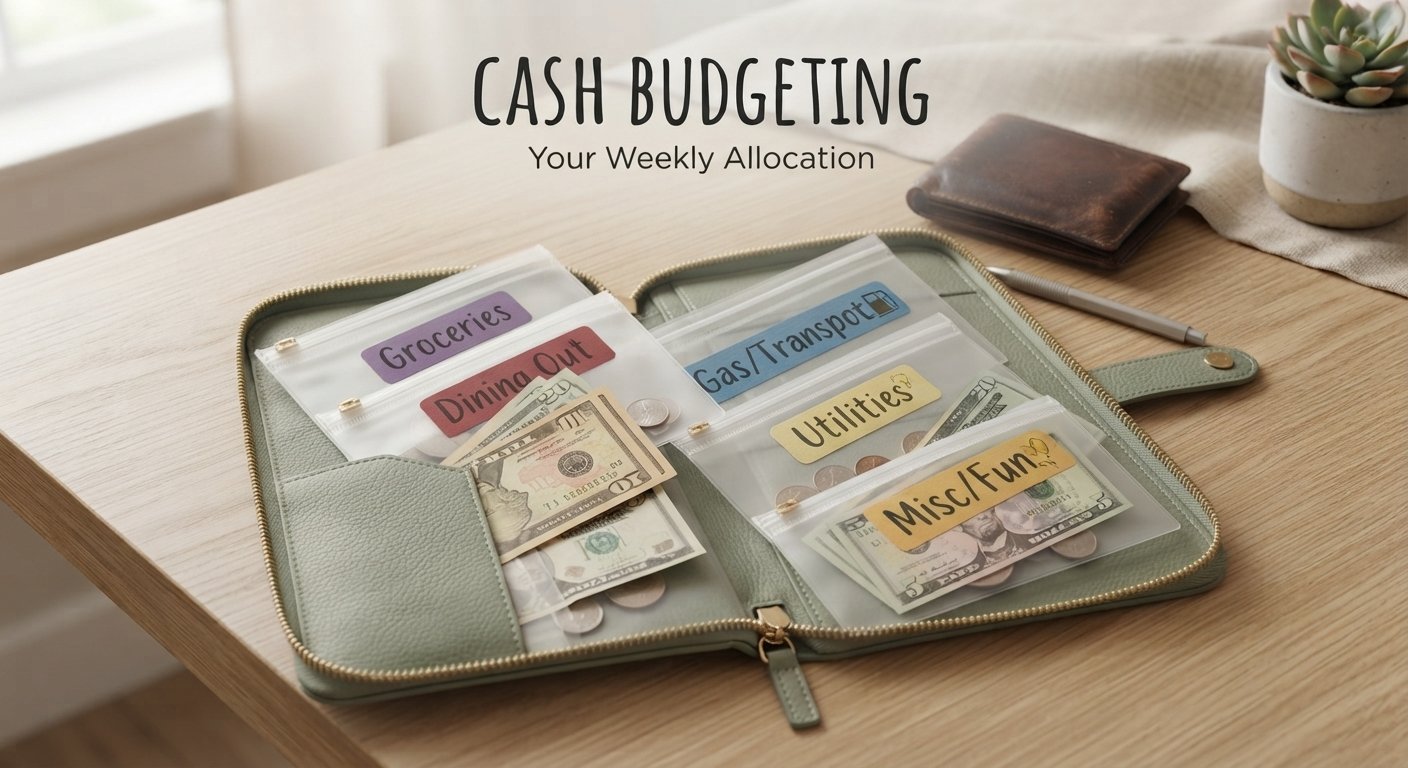
If you have ever finished the month wondering where your grocery money went, the cash envelope system might be exactly what you need. It is one of the oldest budgeting methods around, and it still works today even in a world of tap-to-pay and digital wallets.
In this guide, you will learn what cash envelope budgeting is, how to set it up, and whether it still makes sense in 2026.
What Is Cash Envelope Budgeting?
Cash envelope budgeting means you take your income, divide it into spending categories, and put the exact amount of cash for each category into its own labeled envelope. When an envelope is empty, you stop spending in that category until next month.
For example, if you plan to spend $400 on groceries this month, you put $400 in cash into an envelope labeled “Groceries.” Every time you shop, you pay with that cash. Once the envelope is empty, no more grocery spending happens until your next budget period.
This is a close cousin of zero-based budgeting — both methods ask you to plan every dollar in advance. The difference is that cash envelope budgeting adds a physical limit. You cannot overspend an envelope, because there is no more money in it.
Cash Envelope Budgeting, aka “Cash Stuffing”
If you have seen budgeting videos on TikTok or Instagram, you may know this method by a newer name: cash stuffing. It is the exact same system dividing cash into labeled categories just repackaged for social media, often with decorative budget binders, colorful envelopes, and stickers.
The name has changed, but the math and the psychology behind it have not. Whether you call it cash envelope budgeting or cash stuffing, the goal is the same: give every dollar a physical home so you can see and feel your spending limits in real time.
Why Cash Still Works Better Than Cards for Some People
It might seem old-fashioned to use paper money in 2026, but there is real psychology behind why it works.
Handing over cash creates what researchers call the “pain of paying.” When you physically watch money leave your hand, your brain registers the loss in a way that swiping a card does not. A widely cited Dun & Bradstreet study found that people spend 12% to 18% more when paying with credit cards instead of cash, because card payments feel less “real” in the moment.
Cash envelope budgeting uses this psychology on purpose. It puts a visible, physical limit in front of you, so overspending becomes obvious immediately not three weeks later when your credit card statement arrives.
Step-by-Step: How to Set Up Cash Envelope Budgeting
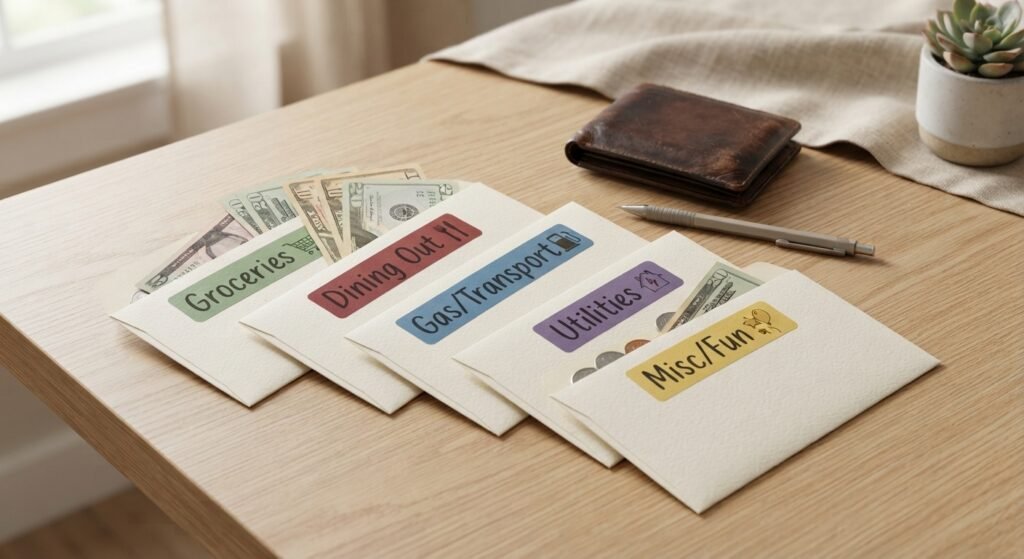
Step 1: Pick Your Categories
Choose the spending categories where you tend to overspend the most. You do not need an envelope for every single expense bills like rent and utilities are usually paid automatically and do not need cash. Cash envelopes work best for variable, everyday spending.
ommon categories include:
- Groceries
- Dining out
- Entertainment
- Personal spending
- Clothing
- Gas
Step 2: Decide How Much Goes in Each Envelope
Look at your last one to two months of spending to set realistic amounts. If you do not have that data yet, estimate based on your income and priorities, then adjust next month.
Example: James has $4,200 in monthly take-home pay. His fixed bills (rent, car payment, insurance, phone, utilities) total $2,300 and are paid by bank transfer, not cash. That leaves $1,900 for variable spending and savings. He sets up his envelopes like this:
| Envelope | Amount |
| Groceries | $500 |
| Dining out | $150 |
| Entertainment | $100 |
| Personal spending | $150 |
| Clothing | $75 |
| Gas | $175 |
| Savings (transferred to a savings account, not cash) | $600 |
| Debt payment | $150 |
| Total | $1,900 |
$2,300 (fixed bills) + $1,900 (envelopes and savings) = $4,200, which matches his full income exactly.
Step 3: Withdraw and Fill the Envelopes
On payday, withdraw the total cash amount for your variable categories and physically split it into each envelope. Label each envelope clearly.
Step 4: Spend Only From the Matching Envelope
When you buy groceries, pay with the grocery envelope. When you go out to eat, use the dining envelope. Never borrow from one envelope to cover another category if you do, you lose the system’s biggest benefit, which is an honest, visible limit.
Step 5: What to Do When an Envelope Runs Out
This is where cash envelope budgeting builds real financial discipline. If your dining envelope is empty by the third week, you stop eating out until next month. This can feel restrictive at first, but it is the entire point the empty envelope is a clear, immediate signal that adjusts your behavior in real time.
If you truly need to reallocate funds, you may move cash between envelopes for example, taking $20 from clothing to cover a grocery shortfall but do this sparingly and track it so your totals still add up correctly.
Digital Cash Envelopes: The 2026 Version
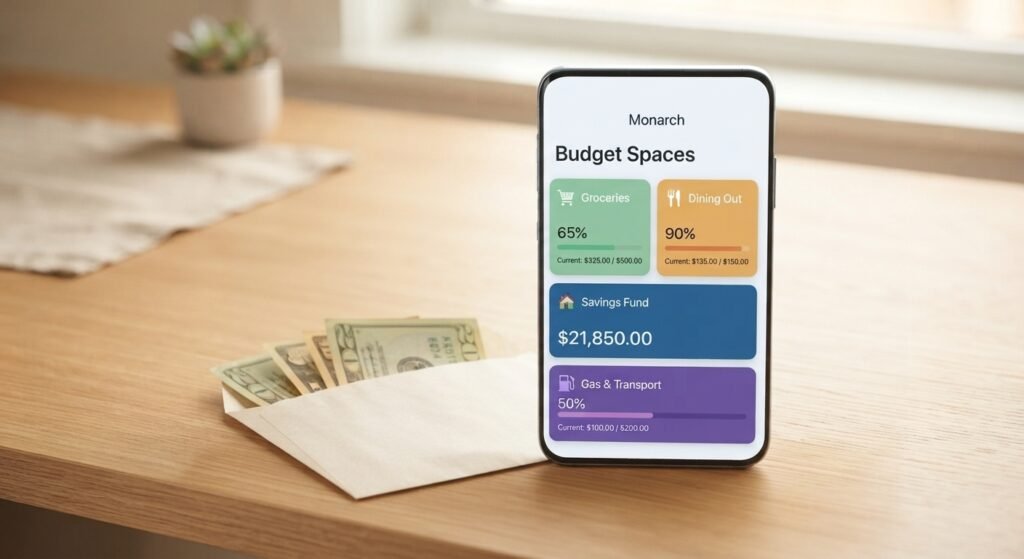
Carrying physical cash is not realistic for everyone, especially with many stores reducing cash acceptance. If that is your situation, digital envelope budgeting can offer a similar effect.
Several banking apps now let you create sub-accounts or “spaces” that function like digital envelopes, you allocate money into named virtual buckets and spend directly from them using a linked debit card. The category still has a hard limit, and you can check the balance instantly, which recreates much of the same visible-limit effect as physical cash.
The tradeoff is that digital envelopes lose some of the psychological “pain of paying” that makes physical cash so effective, since you are still swiping a card. If you find you overspend even with digital envelopes, it may be worth testing physical cash for your highest-risk categories, like dining out or clothing, while keeping the rest digital.
Pros and Cons of Cash Envelope Budgeting
Pros:
- Makes overspending immediately visible
- Uses proven psychology to reduce impulse purchases
- Simple to understand, no app or spreadsheet required
- Works well for people who tend to overspend with cards
Cons:
- Carrying cash has some safety and convenience downsides
- Does not build credit history the way responsible card use does
- Harder to use for online purchases
- Requires a trip to the bank or ATM each pay period
Common Mistakes to Avoid
- Making too many envelopes. Start with three to five categories where you actually struggle. You can add more later.
- Refilling an empty envelope mid-month. This defeats the purpose. If an envelope runs out, that is a signal to adjust next month’s amount, not to add more cash now.
- Forgetting to track cash spent. Even though it is cash, jot down what you spend so you can review your habits at the end of the month.
- Using it for every expense. Cash envelopes work best for variable spending. Automate fixed bills instead.
Is Cash Envelope Budgeting Right for You?
This method works especially well if you:
- Tend to overspend when using cards
- Struggle to stick to a budget on paper or in an app alone
- Want a simple, visual way to control specific spending categories
It may not be the best fit if you rarely carry cash, live somewhere cash is not widely accepted, or prefer to track everything digitally. In that case, a digital envelope app or a zero-based budget using a spreadsheet may suit you better.
Getting Started This Week
You do not need to convert your entire budget to cash right away. Start small:
- Pick one or two categories where you overspend the most, such as dining out or entertainment.
- Withdraw that amount in cash for the next two weeks.
- Track how it feels to watch the envelope get lighter as you spend.
Many people find that even trying this with just one category changes how they think about spending everywhere else. The cash envelope system has worked for decades because it turns an abstract number into something you can physically see and feel and that simple shift is often all it takes to build lasting money habits





1 Comment