


Do you ever look at your bank account and wonder where your paycheck went? You are not alone. Many people earn a good income but still feel like their money disappears every month. Zero-based budgeting can fix that. It is one of the simplest and most effective smart ways to save money. In this guide, you will learn what it is, how it works, and how to build your own zero-based budget with real numbers.
What Is Zero-Based Budgeting?
Zero-based budgeting means you give every dollar you earn a job. Your income minus your expenses should equal zero. This does not mean you spend everything and have nothing left. It means every dollar is planned for something, including savings and debt payments. If money is left over, you assign it a job too, such as extra savings or an extra debt payment.
The simple formula is:
Income − Expenses = 0
Notice this is different from just “not spending too much.” Zero-based budgeting asks you to plan ahead, before the money arrives, rather than just watching your spending after the fact.
Why Zero-Based Budgeting Works
Most budgeting methods fail because they are too vague. Saying “I’ll spend less on food” does not tell you how much to spend or when to stop. Zero-based budgeting removes the guesswork.
Here is why it works so well:
- It forces intention. You decide where your money goes before you spend it, not after.
- It catches wasted money. Small, forgotten subscriptions and habits show up clearly when every dollar must be listed.
- It adjusts every month. Your income and expenses change, so your budget changes with them. You are not stuck using last month’s numbers.
- It reduces financial stress. When every dollar has a purpose, you stop worrying about surprise shortfalls.
Step-by-Step: How to Build a Zero-Based Budget
Step 1: Calculate Your Monthly Income
Add up all the money you expect to receive this month after taxes. This includes your paycheck, side income, or any other regular money coming in.
Example: Sarah brings home $3,800 per month from her job, plus $200 from a part-time weekend job. Her total monthly income is $4,000.
Step 2: List Every Expense
Write down everything you spend money on. Split expenses into three groups:
Fixed expenses – rent, car payment, insurance, phone bill
Variable expenses – groceries, gas, entertainment
Savings and debt payments – emergency fund, retirement, credit card payments
Do not skip small expenses. A $12 streaming subscription and a $6 coffee habit both need a line in your budget.
Step 3: Assign Every Dollar a Job
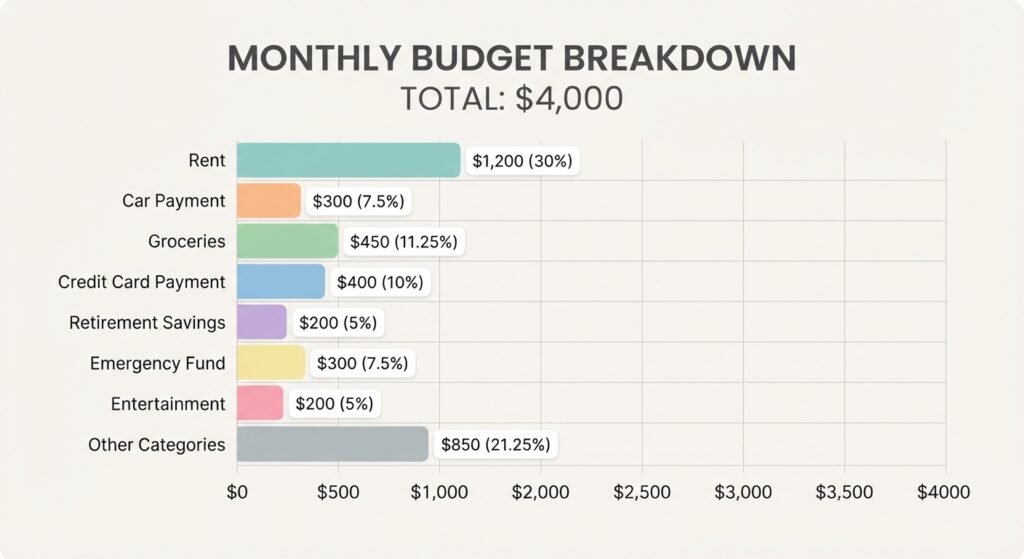
Now match your income to your expenses until you reach zero. Here is Sarah’s example budget:
| Category | Amount |
| Rent | $1,200 |
| Car payment | $300 |
| Car insurance | $110 |
| Phone bill | $55 |
| Groceries | $450 |
| Gas | $120 |
| Utilities (electric, water, internet) | $215 |
| Emergency fund | $300 |
| Credit card payment | $400 |
| Retirement savings | $200 |
| Entertainment and dining out | $200 |
| Personal spending | $150 |
| Clothing | $50 |
| Miscellaneous/buffer | $250 |
| Total | $4,000 |
Income ($4,000) − Total expenses ($4,000) = $0
Every dollar has a job. Nothing is left unplanned, and nothing is overspent.
Step 4: Track Your Spending All Month
A budget only works if you follow it. Check your spending weekly, not just at the end of the month. If you spend $60 at the grocery store, subtract it from your $450 grocery category right away.
You can track this with a notebook, a spreadsheet, or a budgeting app. The tool does not matter as much as the habit of checking in regularly.
Step 5: Adjust When Life Happens
If you overspend in one category, move money from another category to cover it. For example, if Sarah spends $500 on groceries instead of $450, she can take that extra $50 from her entertainment budget.
This is the flexible part of zero-based budgeting. You are not failing if you go over in one area you are simply moving money to keep your total at zero.
A Real Example: Adjusting for Debt
Let’s say Sarah wants to pay off her $400 credit card balance faster because it carries a high interest rate. According to Federal Reserve data, the average credit card interest rate in the United States was around 21% in 2026. On a $400 balance carried for a full year at that rate, she would pay roughly $84 in interest if she only made minimum payments.
To avoid that cost, Sarah decides to cut her entertainment budget from $200 to $120 and put the extra $80 toward her credit card. Her new budget still equals zero, she has simply redirected money toward a goal that matters more to her right now.
This shows the real power of zero-based budgeting: it is not about spending less overall, it is about choosing where your money goes on purpose.
Common Mistakes to Avoid
- Forgetting irregular expenses. Car repairs, birthdays, and annual subscriptions do not happen every month, but they still need a spot in your budget. Divide the yearly cost by 12 and save that amount monthly.
- Being too strict. If your budget has no room for fun, you are more likely to quit. Always include some spending money.
- Not adjusting mid-month. Life changes. If your income or expenses shift, update your budget right away instead of waiting until next month.
- Giving up after one bad month. One overspent category does not mean the system failed. Adjust and keep going
Zero-Based Budgeting vs. Other Methods
ou may have heard of the 50/30/20 rule, where 50% of income goes to needs, 30% to wants, and 20% to savings. That method is simpler, but it is also less precise.

Zero-based budgeting takes more effort upfront, but it gives you full control. Instead of general percentages, you plan the exact dollar amount for each expense. This makes it especially useful if you are trying to pay off debt, save for a specific goal, or simply feel unsure about where your money goes each month
Getting Started This Week
You do not need a perfect budget on your first try. Start with these three actions:
- Write down your total income for next month.
- List every expense you can think of, even small ones.
- Assign every dollar until your total reaches zero.
Your first budget will not be perfect, and that is okay. The goal is progress, not perfection. Each month, your numbers will get more accurate as you learn your real spending habits.
Final Thoughts
Zero-based budgeting puts you back in control of your money. Instead of wondering where your paycheck went, you decide in advance exactly where it will go. It takes a little more time each month than other budgeting methods, but the payoff is real: less stress, faster debt payoff, and steady progress toward your financial goals.
Start with next month’s paycheck. Give every dollar a job, and watch how much clearer your finances become.







5 Comments