


The 52-week savings challenge is one of the simplest ways to build a savings habit without overhauling your whole budget. You start small, add a little more each week, and by the end of the year you have $1,378 sitting in your account.
According to the Federal Reserve’s latest report on household well-being, only 63% of U.S. adults would cover a surprise $400 expense with cash or its equivalent. A finished challenge puts you well past that line.
This guide explains exactly how the challenge works, the math behind it, and five variations you can pick from if the classic version doesn’t fit your paycheck.
Table of Contents
What Is the 52-Week Savings Challenge?
The 52-week savings challenge is a year-long saving plan where the amount you set aside matches the week number. In week 1 you save $1. In week 2 you save $2. In week 3, $3. You keep going until week 52, when you save $52.
Add up all 52 deposits and you get $1,378.
The appeal is that the early weeks are almost painless. Saving $4 or $5 doesn’t require you to cut anything. By the time the amounts get bigger, saving has already become part of your routine.
The 52-Week Savings Challenge Chart
Here is how your balance grows through the year:
| Weeks | Weekly deposit | Running total at end |
|---|---|---|
| 1–4 | $1 to $4 | $10 |
| 5–13 | $5 to $13 | $91 |
| 14–26 | $14 to $26 | $351 |
| 27–39 | $27 to $39 | $780 |
| 40–52 | $40 to $52 | $1,378 |
Notice something important: you save only $351 in the first half of the year and $1,027 in the second half. That back-loaded structure is the challenge’s biggest weakness, and it’s the reason so many people quit around October.
Why the Classic Version Is Hard to Finish
The final quarter of the year is often the most expensive. Holiday gifts, travel, and year-end bills all land at the same time the challenge asks you to save $40 to $52 a week.
If you start in January, weeks 48 through 52 fall in December. That’s $250 in savings due during the most expensive month of the year. Many people hit that wall and abandon the plan, sometimes even dipping into what they’ve already saved.
But the total is what matters, not the order, so you can rearrange the deposits to fit your life.
5 Variations of the 52-Week Savings Challenge
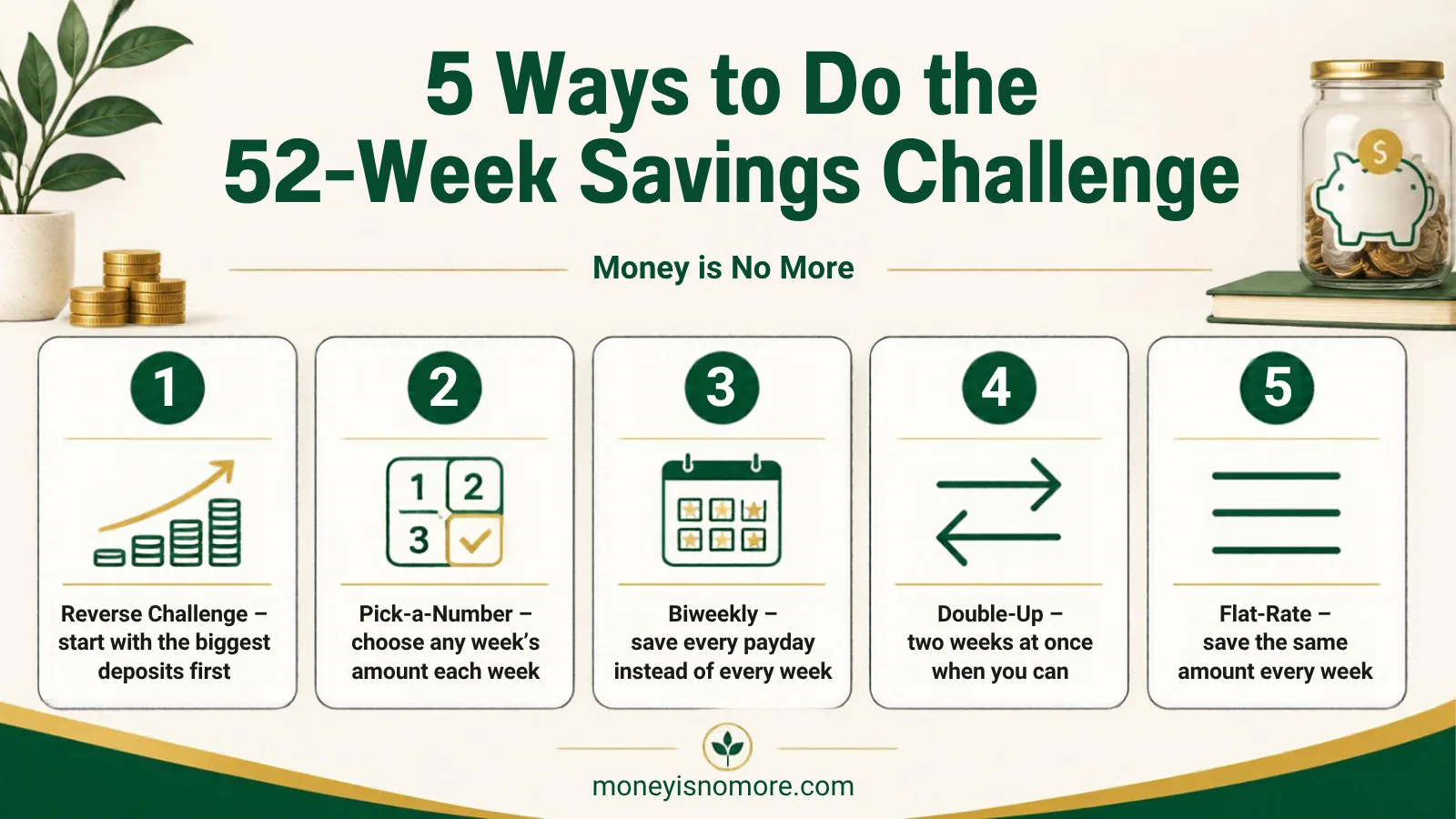
1. The Reverse Challenge
Start at $52 in week 1 and count down to $1 in week 52. You still save $1,378, but the hardest weeks come first, when your motivation is highest. December becomes the easiest month instead of the hardest.
This is the version most people should try first.
2. The Pick-a-Number Challenge
Print a chart with the numbers 1 through 52. Each week, cross off whichever amount fits your budget. Tight week? Save $3. Got a bonus or extra shift? Knock out $50.
You still reach $1,378 once every number is crossed off, and you control the pace.
3. The Biweekly Challenge
If you’re paid every two weeks, saving weekly can feel out of sync with your cash flow. Instead, combine two weeks into one deposit on payday. Paycheck 1 is $3 ($1 + $2), paycheck 2 is $7 ($3 + $4), and so on. The final payday deposit is $103.
Not sure how many paychecks you’ll get this year? Our guide on how many pay periods are in a year breaks it down.
4. The Double-Up Challenge
Ready for a bigger goal? Save $2 in week 1, $4 in week 2, $6 in week 3, and keep adding $2 each week. Your final deposit is $104, and your year-end total is $2,756.
This version works well if you already have a stable budget and want something more ambitious.
5. The Flat-Rate Challenge
Divide $1,378 by 52 and you get about $26.50 a week. Saving the same amount every week is less exciting, but it’s predictable and easy to automate. Set up a recurring transfer and forget about it.
If you want to scale up from here, our step-by-step plan on how to save $10K in a year uses the same weekly approach with bigger numbers.
How to Set Up the Challenge So You Actually Finish
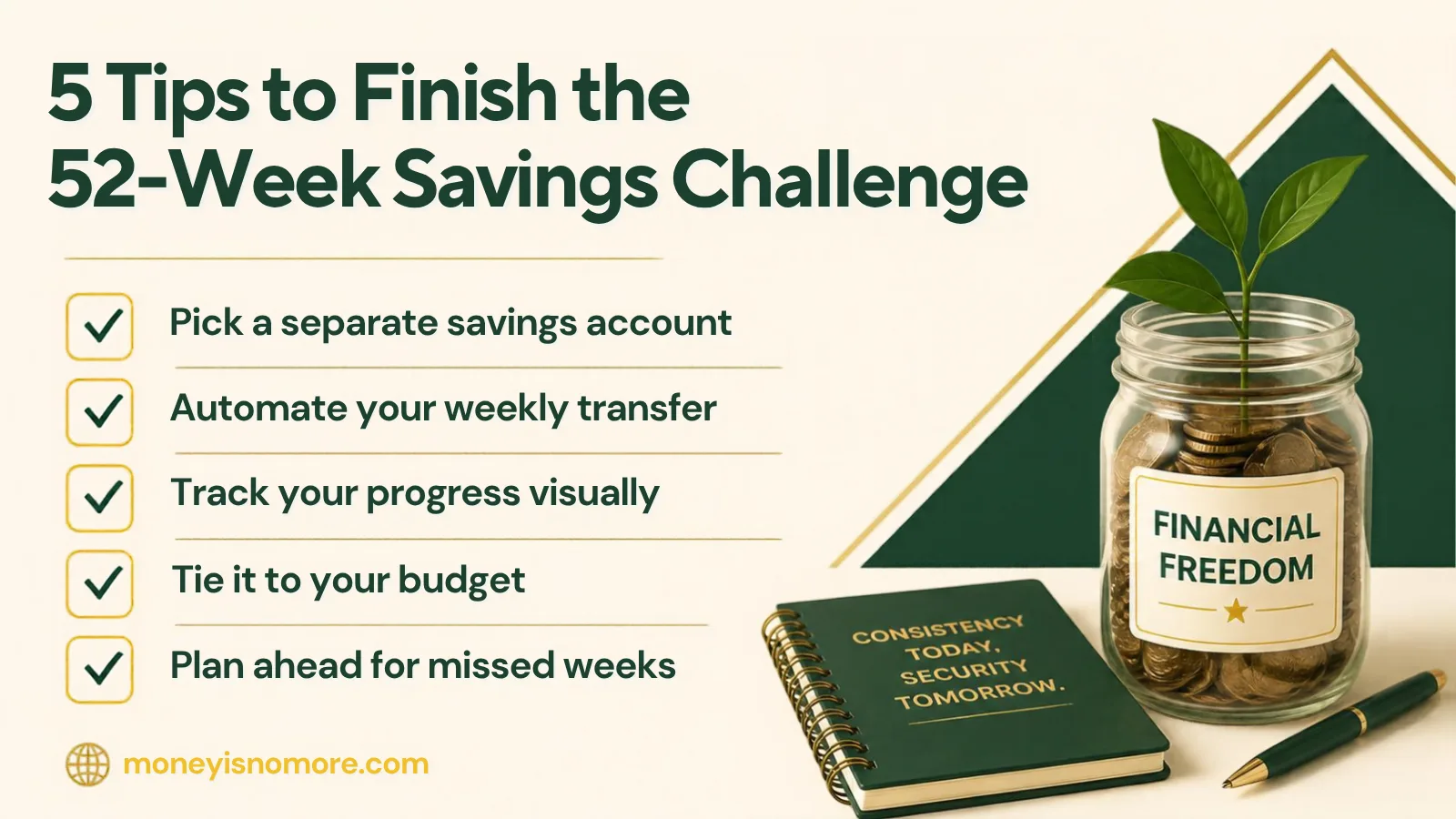
Pick a separate account
Keep your challenge money out of your checking account. If it’s sitting next to your spending money, it will get spent. A separate high-yield savings account works well because you’ll also earn some interest along the way. Check that it’s FDIC– or NCUA-insured.
Automate it if you can
Most banks let you schedule recurring transfers. For the classic or reverse challenge, you’ll have to update the amount each week, but some banking apps let you set up a series of scheduled transfers in advance. For the flat-rate version, one recurring transfer is all you need.
Track your progress visually
There’s a reason printable savings charts are so popular. Crossing off a number or coloring in a box gives you a small win every week, and those small wins keep you going. A paper chart on the fridge works just as well as any app.
Tie it to your budget
The challenge works best when it has a home in your budget. If you use zero-based budgeting, give the challenge its own line. If you follow the 50/30/20 rule, count it as part of your 20% savings bucket.
Plan for missed weeks
You will probably miss a week at some point. That’s fine. Don’t try to catch up all at once. Just add the missed amount to the next few weeks in small pieces, or switch to the pick-a-number version for the rest of the year.
What Should You Do With the $1,378?
Before you start, decide what the money is for. A clear purpose makes it much easier to keep going. Good options include:
- Starting an emergency fund. This is the best use for most people. $1,378 covers many common surprises, like a car repair or a medical bill.
- Paying down high-interest debt. If you carry a credit card balance, putting the money toward it can save you more than any savings account will earn.
- Funding a specific goal. A holiday budget, a trip, or new tires. Saving ahead means you won’t need to put it on a card.
- Building a bigger savings habit. Once you finish, try the double-up challenge next year.
If money is especially tight right now, read our guide on how to stop living paycheck to paycheck before starting. It covers the first steps for creating breathing room in your budget.
Is the 52-Week Savings Challenge Worth It?
Yes, especially if you’ve struggled to save consistently before. The challenge isn’t really about the dollar amount. It’s about proving to yourself that you can save every single week for a year.
That habit is worth far more than $1,378. Once saving becomes automatic, you can raise your goal, increase your deposits, and move on to bigger targets like a full emergency fund or investing.
If you are new to saving, start with whichever version of the 52-week savings challenge feels easiest. You can always switch to a tougher version later, and finishing a smaller challenge beats quitting a bigger one halfway through the year.
Frequently Asked Questions
How much do you save in the 52-week challenge?
The classic 52-week savings challenge saves $1,378 in total. The double-up version, where you add $2 each week, saves $2,756.
Can I start the 52-week challenge in the middle of the year?
Yes. Week 1 is simply the week you start. There’s no rule that says it has to begin in January. Starting mid-year can even help you avoid the December crunch.
What is the easiest version of the challenge?
The reverse challenge or the pick-a-number challenge are the easiest to finish because they let you handle the biggest deposits when you have the most motivation or extra cash.
Where should I keep my 52-week challenge savings?
Use a separate savings account, ideally a high-yield savings account that is FDIC- or NCUA-insured. Keeping it separate from checking makes it less likely you’ll spend it.
What if I miss a week?
Spread the missed amount over the next few weeks or switch to the pick-a-number version. Missing one week doesn’t mean the challenge is over.







Leave a comment